Overview
The Prism Conversion System (Prism-CS™) is the
best software product designed to automate the conversion of DOS/VSE,
VSE/SP, VSE/ESA and z/VSE applications to MVS, OS/390 and z/OS.
Prism-CS includes a set of integrated components to load and
validate the application inventory, convert and compile programs,
translate JCL streams, and transfer application data.
Prism-CS significantly reduces the time required to convert
the applications by automating repetitive tasks, thereby allowing the team
in charge of migrating a VSE data center to OS/390 or z/OS to concentrate
on other migration activities, such as planning, training, system tests,
and coordination.
Prism-CS is designed for the mass-conversion
method to convert an entire VSE data center to MVS over a week-end.
With its advanced mass-processing capabilities, Prism-CS
reduces the time it takes to complete a migration project, while relieving
the applications staff from having to freeze (or track maintenance applied
to) the applications during the course of the migration.
The design of Prism-CS encompasses a vast amount of
experience accumulated on dozens of conversion projects since 1980,
resulting in a state-of-the-art product, which is continuously and
actively maintained
and enhanced.
The extreme versatility of Prism-CS is demonstrated in a
set of translated real-world job
streams which include VSE JCL, in-line programs and utility steps, as
well as the resulting MVS job streams, which were automatically generated
by the JCL
Translator. Due to its versatility, Prism-CS can handle
a wide variety of situations that arise from the use of IBM and non-IBM
software products within the VSE applications, and is currently ready to
support the following:
- Cobol, Assembler, PL/I, RPG II, Fortran
- Easytrieve, Easytrieve-Plus, Dylakor (DYL260, or Vision:Sixty and
DYL280, or Vision:Results), QuikJob (Vision:Report), Natural, CA-Earl,
Mantis, Ideal, SAS
- VSE JCL, VSE/POWER JECL, EPIC JCL, SPRI
- VSE PROCs, POWER SLIs, most INCLUDEs
- CA-Dynam/D/T/FI, EPAT, EPIC, CA-System/Manager, DiskMaster/VSE,
TapeMaster/VSE, ADAS, SYSB-II, PSAM, MSAM
- SORT/MERGE utilities (CA, CSI, IBM, SYNCSORT), ICETOOL, CA-SRAM,
CA-DART
- IDCAMS, DITTO, CLRDK, DRET
- DL/I, DB2, Datacom/DB, IDMS, Adabas, Total/Supra, Model 204
- APPC, MQSeries, PSF/VSE
- DrD, DUSP, Faver, Faver2, MaxBack, WDU, FCOPY, TSIDOFL, DATABACK,
SelCopy, KwikKey, KwikLod
- MTPBATCH, IPCPBTCH, JCLBCICS, BEMT
- FTP, FTPBATCH, BSTTFTPC, NetView FTP, VSE2PDF, XCOM, Outbound,
BIMFTRBC, INWMUTIL, LANRES, GENIOS, CFTUTIL
- KeyFast, KeyMaster and ODE
- Linkage-editor control statements
- VSE Conditional JCL, EPIC JMCL, CA-Driver, FAQS/PCS PCL/ECL,
Software Pursuits PLF
- FAQS/PCS, CA-Scheduler, Zeke
- VSE Libraries, ICCF, VM/CMS, Librarian, Panvalet, VOLLIE
- MVT/VSE, EDOS/VSE
Prism-CS is designed for high-performance, low overhead
and runs on any MVS/ESA, OS/390 or z/OS system. Once a sufficient level of
tailoring has been applied, an average-size inventory can be completely
processed in half a day, i.e. a complete set of programs, JCL and data
files can be captured from the VSE environment, restored onto the MVS
system, converted, and made available for testing in a matter of hours.
Since 2000, Prism-CS has helped dozens of VSE data
centers migrate their applications smoothly to OS/390 and z/OS.
Components

Prism-CS is made up of several sub-systems, fully
integrated with each other:
Prism-CS also includes the ARCHIVER, COMPILES, PDSEDIT and PDSUTIL products.
Other GSF Software Products
may be bundled with Prism-CS for an additional fee.
Prism-CS Design
Prism-CS follows a logical design that makes emphasis in a mass conversion approach.
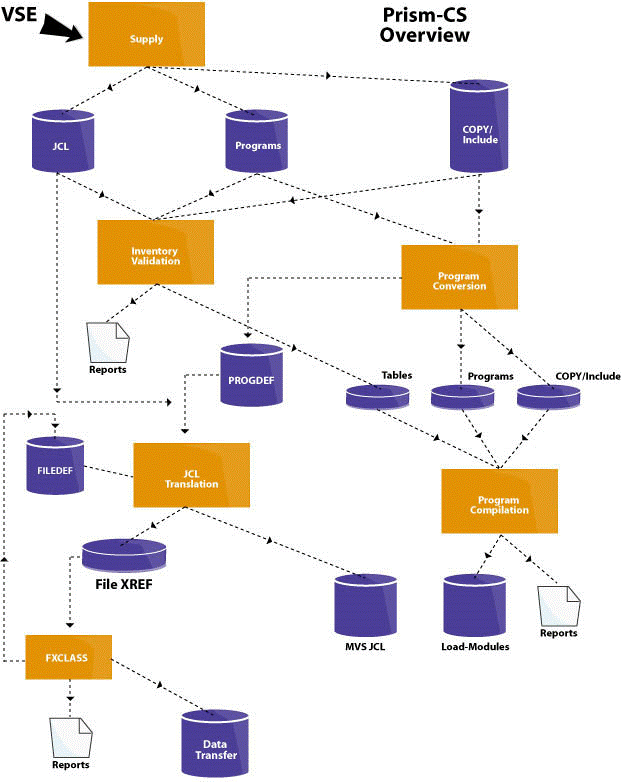
Inventory Processing
Inventory
Processing consists of:
- Input Formatters, a set of utility programs to load the
contents of tapes created in VSE or VM/CMS into standard MVS Partitioned
data sets.
- JCL Expansion creates an intermediate version of the VSE JCL
in which all SLIs, PROCs and INCLUDE have been expanded. This greatly
facilitates the analysis of the JCL streams and is a pre-requisite to
Inventory Validation and JCL Translation.
- Inventory Validation analyzes the JCL, programs and CICS
tables to find the relationships between the different objects and
produces a set of reports that identify missing and unreferenced
elements.
Language Conversion Programs
Language Conversion
Programs (LCP) process VSE source programs written in COBOL,
Assembler, PL/I, RPG II and several non-IBM languages, and automatically
make syntax changes necessary to adapt the source code to the MVS version
of the compiler. LCPs also create the program definition tables (PROGDEF)
that are required to drive the JCL translation process.
Programs written in non-IBM languages (Easytrieve, Dylakor, QuikJob,
CA-Earl, SAS, Natural, Mantis, Ideal) can be in-line (the source code is
imbedded in the JCL), or off-line (the source code is stored in separate
libraries). In both cases, non-IBM languages are processed by the same set
of LCPs which make necessary changes to the source code and produce
program definition tables for the JCL translator.
Mass Compiler
The Mass Compiler, COMPILES, is a
software "robot" that controls the compilation of application programs and
greatly speeds-up the process by eliminating most of the human and machine
overhead which results from using more traditional compilation procedures.
The mass-compiler is compatible with standard IBM compilers, as well as
most HLLPI pre-processors (CICS, DLI, DB2, etc) and non-IBM languages.
JCL Translator
The JCL Translator, JCLTRANS, converts
VSE JOB streams to their MVS equivalent, using tables created by other
components, e.g. Language
Conversion Programs (LCPs) or FXCLASS, the file classification
utility. The JCL Translator converts JCL and JECL statements, utility
steps and their control cards, as well as source statements for in-line
programs such as Easytyrieve or Dyl280.
The versatility of the JCL Translator is demonstrated in a set of real-world job
streams which include VSE JCL, in-line programs and utility steps, as
well as the resulting MVS job streams, which were automatically generated
by JCLTRANS.
The FXCLASS utility is an important auxiliary to JCLTRANS which
assigns a class to every file in the inventory. File classes are used by
FXCLASS plug-in modules to automatically calculate MVS attributes,
such as data set name, number of generations, space or SMS classes.
Data Transfer
Prism-CS Data Transfer
tools generate VSE & MVS JCL streams to transfer VSE application data
to MVS for testing, as well as for the final cut-over. Data Transfer
tools use tables created by the JCL Translation process which they combine
with information from VSE disk and tape
catalogs and VTOCs to automate the creation of the VSE and MVS data
transfer streams.
Run-time Library
The Prism-CS Run-time Library is
a set of optional programs that are sometimes needed to provide functions
which are used in VSE programs or job streams, but have no exact
equivalent in the MVS world, such as the // DATE card in the JCL or
the COMRG and SEGMENT macro instructions in assembler programs.
Documentation
The Prism-CS documentation is a set of Web pages
available to licensed users on the World-wide Web or on CD-ROM. Full
access to the documentation pages requires a Web browser that supports the
CSS2 Specification.
System Requirements
Programming Requirements
- Prism-CS runs in the MVS/ESA, OS/390, z/OS and z/OS.e
environments. Prism-CS converts applications the same way,
regardless of the environment.
- On an MVS/ESA system, Assembler H or the High-level Assembler must
be available for customisation. The COBOL for OS/390 and VM V2R2 or the
Enterprise COBOL compiler is required to write customisation exit
routines, LCPs or plug-in modules in COBOL. The Enterprise PL/I compiler
is required to write LCPs and plug-in modules in PL/I.
Machine Requirements
- Prism-CS components are very efficient and run in
minutes with minimal CPU usage. An LPAR or VM guest on a low-end S/390
machine such as an MP3000 or a z/890 running z/OS.e is perfectly
adequate to run Prism-CS.
- Prism-CS requires 20MB of DASD space for its
installation. Additional DASD space is required to hold the equivalent
of three copies of the source code inventory.
Distributors
Prism-CS is available world-wide. Pricing follows a
tiered model, in which both the cost and duration of a license are based
on the size of the conversion inventory.
To purchase a Prism-CS License or obtain additional
information, please contact GSF Software which also
offers a set of related consulting and professional services (see below)
in conjunction with world-wide partners. In Japan, please contact K.K. Paradox.
Service Offerings
GSF Software offers a set of optional, fee-based services to help
Prism-CS licensees make the most of the software product.
|
|
 Prism Conversion System™